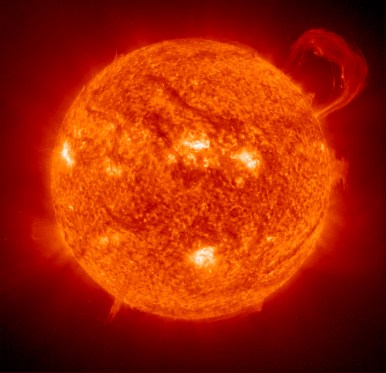
The sun…. from our point of view it seems like it’s just a shiny ball of gas that lights us up everyday and gives us great tans. But it’s so much more than that, in fact , we could say that the sun is God. It has the power to kill us,burn our fertile lands, dry rivers and lakes but without it no life would have been formed, and we wouldn’t exist.No oceans,mountains, buildings,bridges, no annoying neighbours… It seems like our entire lives spin around the sun, well, as we all know they actually do, like all the other planets and celestial objects in the solar system we make an elliptical orbit around it. The sun is 4.5 billion years old, it’s about 150 000 000 kilometers away from us, it has a diameter of 1392530 kilometers and it’s almost 110 times bigger than the Earth.
Our star is medium sized compared to some, but it’s still pretty big given that only 1 out of 10 stars are bigger than the sun. Has I mentioned before the sun is 4.5 billion years old, so it’s “life” is reaching the end because in 5 million years the sun will run out of hydrogen and turn into a red giant, “swallowing” or at least burning the Earth.
Its light takes about 8 minutes to reach us, so, if the sun would magically dissapear, we would only notice that it was gone after 8 minutes.
The sun is made of 78% hydrogen , 20% helium and 2% heavier elements . In the sun the temperatures can reach up to 15 million degrees celsius. Such high temperatures lead to nuclear fusion: the hydrogen turns into helium through a series of isolated reactions, releasing energy. This energy is released in the form of radiations. It has many layers like the photosphere(it separates the interior and exterior of the sun), the cromosphere( above the photosphere), the core and the radiation zone(located in the center of the sun and responsible for the fusion processes that lead to the production of energy),right above the radiation zone there’s the convection zone(where the energy is transportated only by the matter movement in that area)and the crown (the exterior layer of the sun that extends for millions of kilometers until it enters the interplanetary space).
The sun’s rotation period on its axis is 25 days at the equator and 36 near the poles.We rotate and orbit the sun, the sun also rotates and orbits the galaxy center.
There’s is much more to know about the sun and we only scratched the surface of it. But maybe someday I’ll do a Part 2.
See you soon, and I hope that I helped you ScienceYourself!
 ScienceYourself